
There is limited information about the machinery that was installed in the Lewisburg Milling & Electric Co. flour mill. News reports in the Greenbrier Independent state that it was a roller mill with a capacity of 60 barrels a day, or about 5 tons of flour a day. The 1905 Sanborn Fire Map shows that there was an 80 HP steam engine with a 50' chimney that powered the machines listed for each floor of the mill. Additional clues can be taken from the descriptions of other roller mills operating in the early 20th century, especially the Boxley grist mill at the Buffalo National River in Arkansas. From these sources, we can infer how the mill might have been configured.
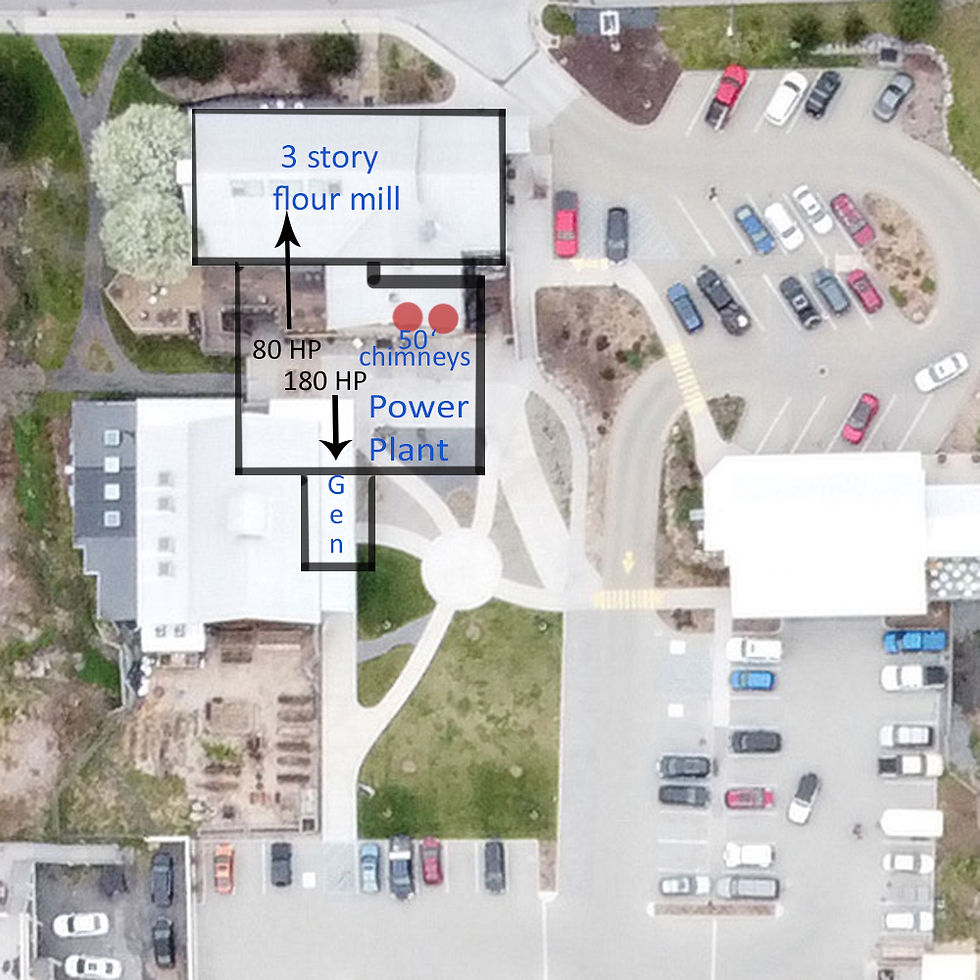


The boiler and chimney were located near the stairs beside the driveway. Steam was piped to the 80HP steam engine that was located between the deck and the Clingman Center. A large leather belt ran into the cellar of the mill approximately where the door below the deck is located. A series of belts and pulleys went up to each floor of the mill and drove line shafts at the ceilings of each floor. Additional belts and pulleys connected each machine in the mill to the overhead line shaft. Grain elevators were long fabric belts with cups attached to it. The elevator brought grain from the first floor up to a machine on an upper floor for further processing.
The Sanborn map lists four roller mills being located on the first floor of the building, a bran duster and separators on the second floor, and a scourer and bolters or sifters on the third floor. This is how the mill might have operated.
On the first floor, grain was dumped into a hopper and a grain elevator brought it up to the third floor where it emptied into the scourer. The scourer rubbed the wheat grains together to loosen dust, chaff, and other impurities and a fan blew those impurities away. The clean grain went down a chute to the first floor where a roller mill coarsely crushed the wheat grains.
Another elevator moved the crushed grain to the bran duster on the second floor. The bran duster separated the bran from the coarsely ground grain. The bran went down one chute to the bran bin on the first floor while the crushed grain went down another chute to one of the other reduction roller mills on the first floor where it was ground more finely.
Another elevator moved the finely ground grain back up to the third floor where it went into the upper end of a bolter or sifter. Bolters had vibrating screens ranging from coarse to fine set on a slope so the fine flour would be sifted out at the high end of the screen and the coarser grains sifted out at the lower end of the bolter. The fine flour would go down a chute to the flour bin on the first floor and the coarser grains would go down other chutes to other roller mills on the first floor. Elevators would take the ground grain from these mills back up to the bolters on the second floor. The fine flour from these bolters went down chutes to the flour bin and the coarser material went down other chutes to a shorts bin. Wheat shorts consist of bran, germ, and flour particles that are not suitable for baking and are often used for animal feed. The first floor of the mill also had hopper scales and equipment for packing the flour in preparation for shipment.
The above principle of how the mill functioned is probably valid, but documentation of the exact layout of the mill has not been located. The way the first roller mill was used is undoubtedly valid, but it is not clear how the other three reduction roller mills were used in conjunction with the bolters. Perhaps a reader can offer additional incites into how the mill might have been configured.
